
A working reference on how these boxes are built, the flute grades and ply types that decide their strength, the standard sizes Indian buyers order most, and what drives the price per box.
Request a quoteWhat is a corrugated box?
A corrugated box is a shipping carton made from corrugated fiberboard — not the thin “cardboard” people often call it. The board is layered: flat outer sheets called liners sandwich a wavy fluted sheet in the middle, and that fluting is what gives the box its stacking strength and its cushioning against shocks in transit.
Because the fluting traps air, the finished board is light for its rigidity, which is why corrugated dominates everything from courier parcels to industrial crating. The same construction can be tuned: thicker flutes absorb more impact, double and triple-wall builds carry heavier loads, and the liner grade decides how well a box survives humidity and how cleanly it takes print. Get those three levers right — flute, ply, and liner — and you have a box matched to the product rather than a generic one that over- or under-protects.
Cardboard vs corrugated. “Cardboard box” is the everyday term, but technically it is a corrugated fiberboard carton. True cardboard (boxboard) is the thin single-layer stock used for cereal cartons and shoeboxes. If it has a wavy middle layer you can see at the edge, it’s corrugated.
Types of corrugated boxes
Most orders fall into a handful of recognised styles. The right one depends on the weight of the contents, how the box is packed, and whether it needs to double as retail display.
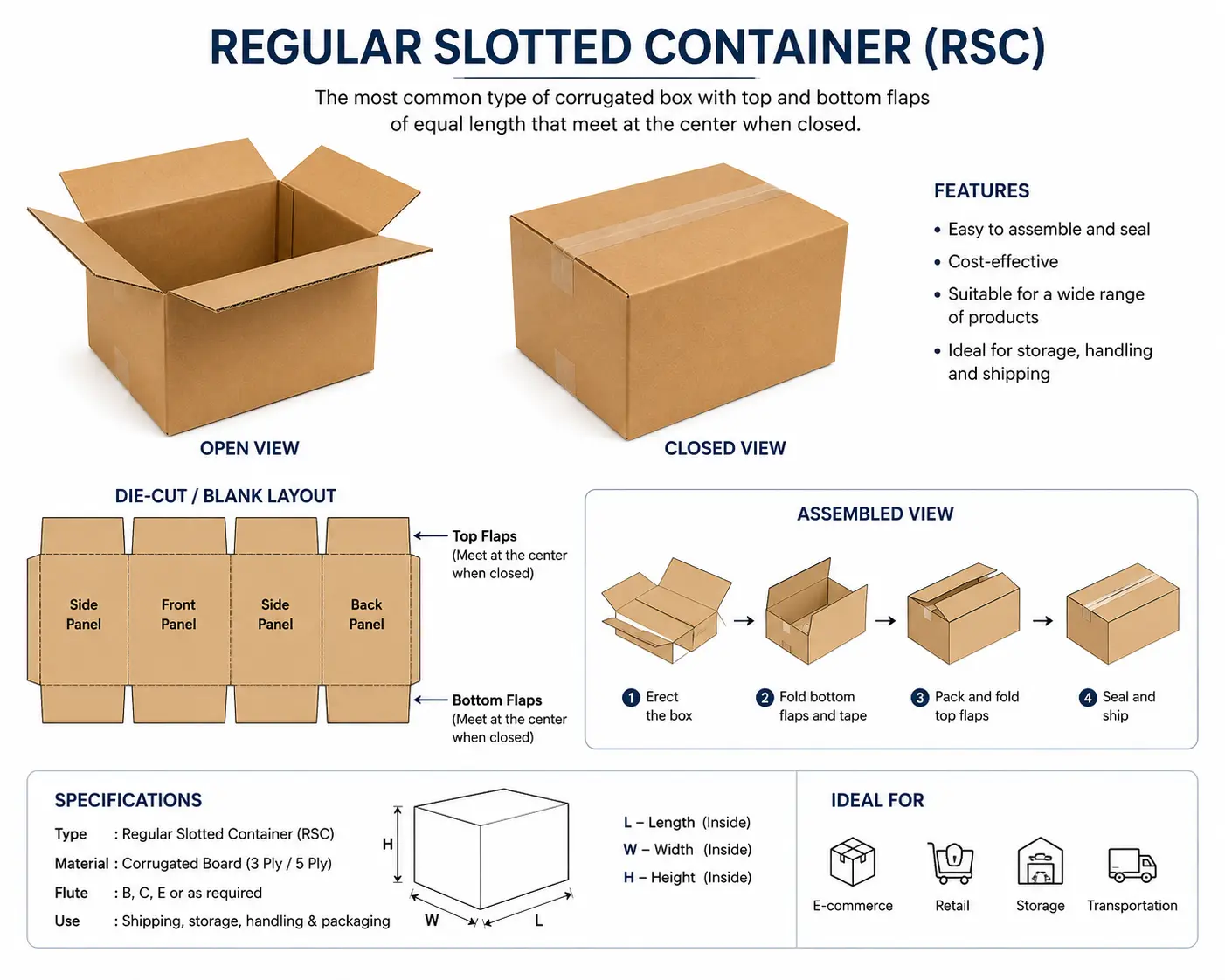
Regular Slotted Container (RSC)
The default shipping box. All flaps are equal length and the outer flaps meet at the centre. Economical, fast to make, and the workhorse of e-commerce and FMCG dispatch.
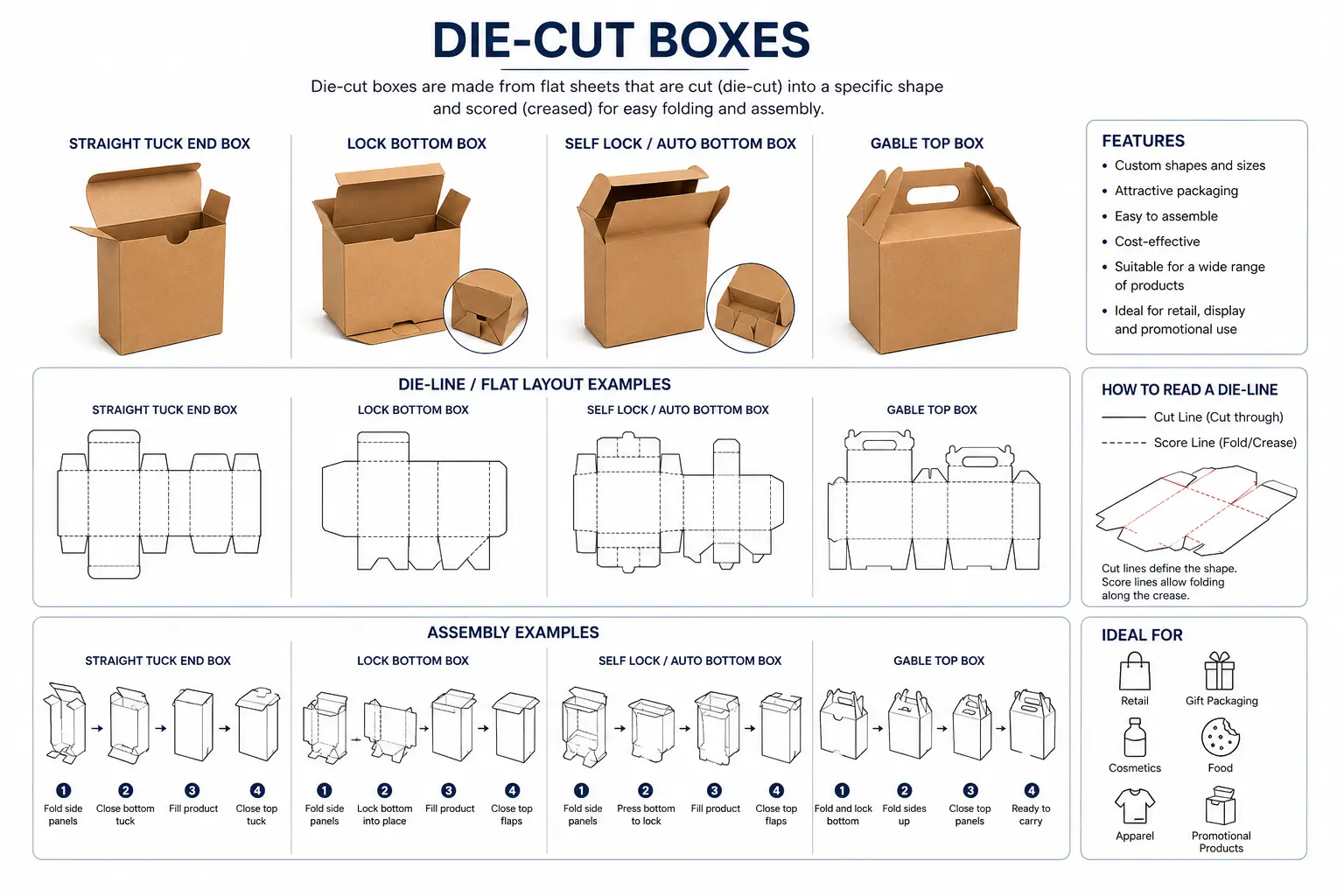
Die-cut boxes
Cut to a custom shape on a die, often self-locking with no tape. Used where fit, presentation, or one-motion assembly matters — think subscription and product packaging.
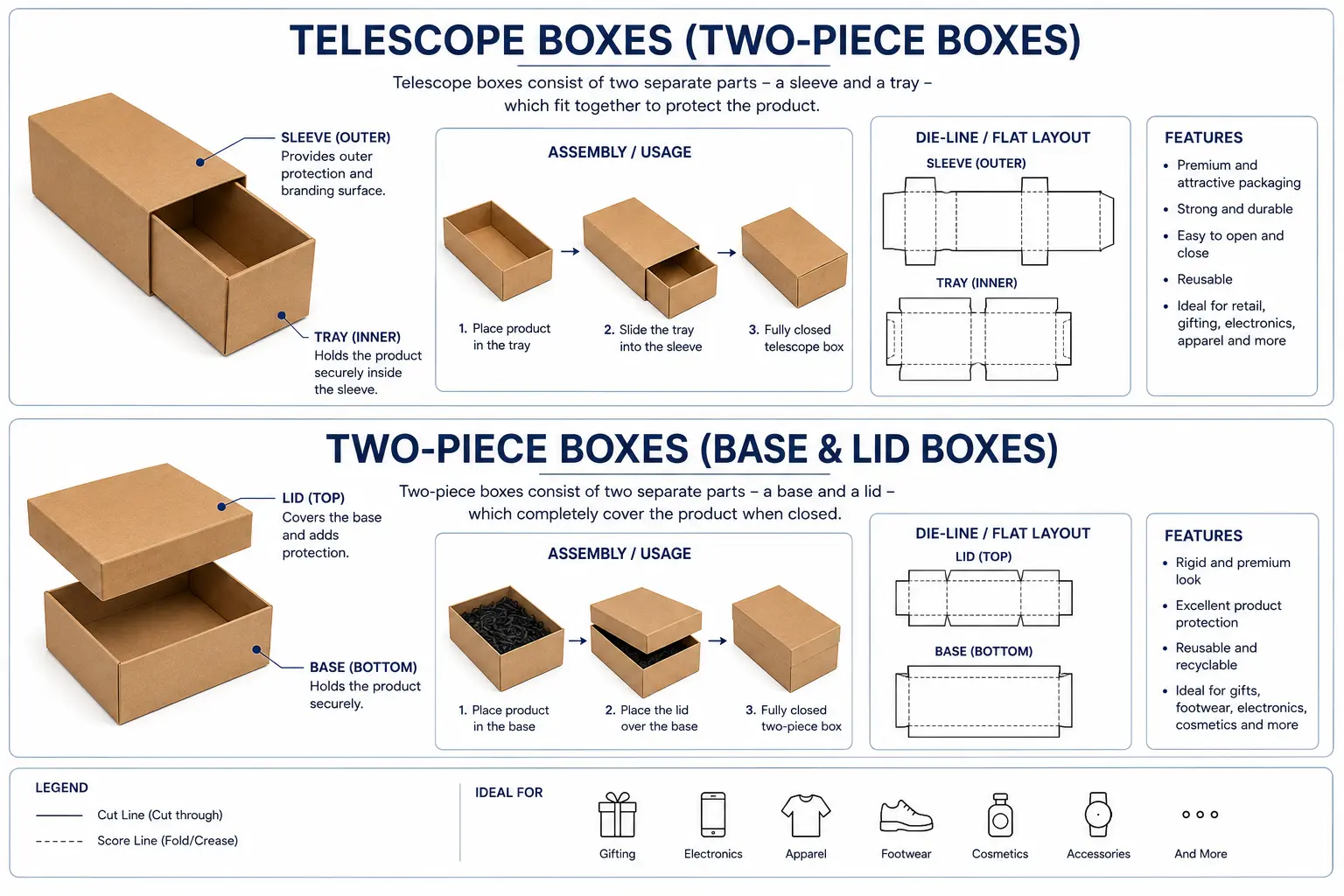
Telescope & two-piece boxes
A separate lid fits over a tray base. Good for heavy or awkward items and for repeated open-close handling.
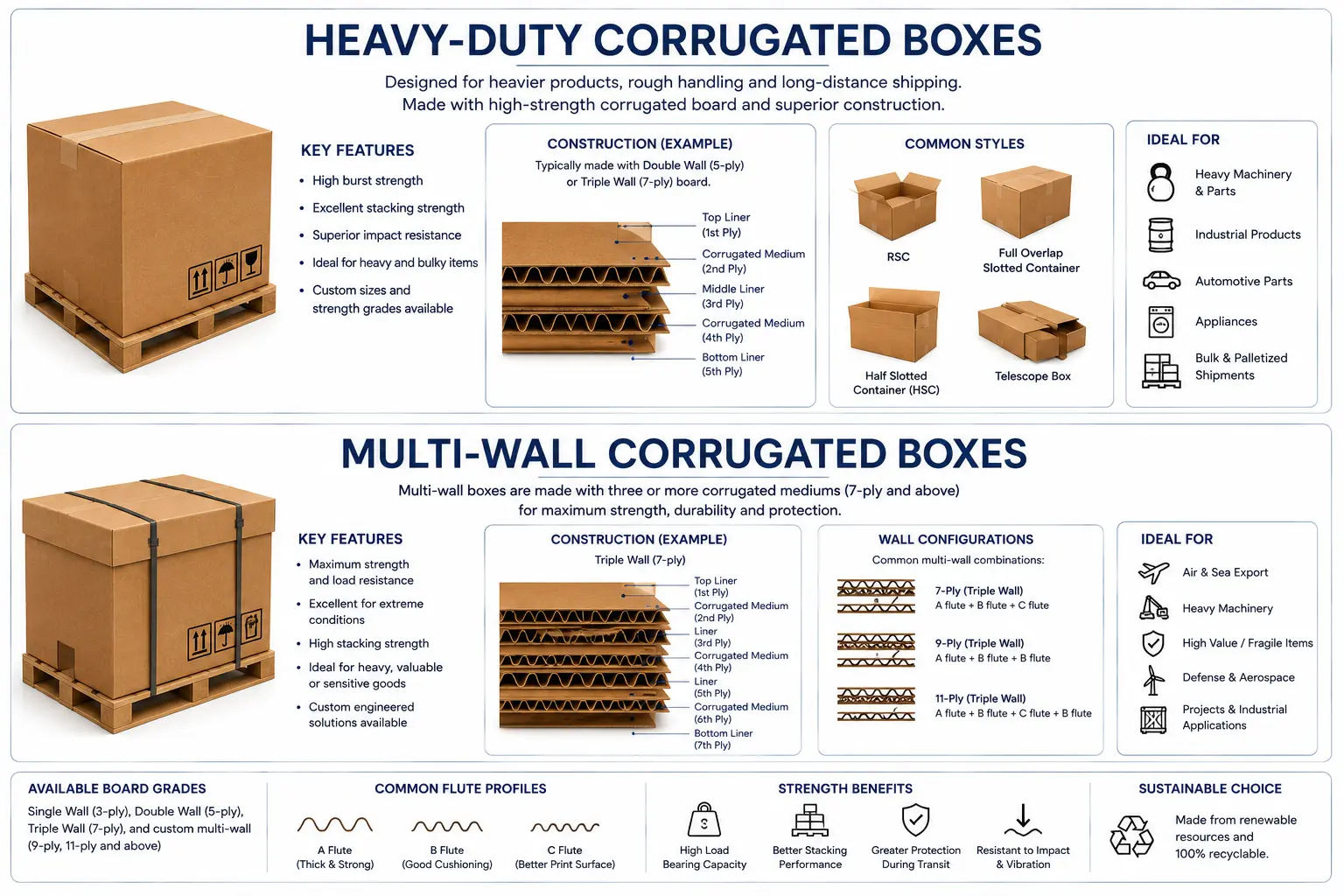
Heavy-duty & multi-wall
Double or triple-wall board for export crating, machinery parts, and stacked palletised loads that need real compression strength.
If you already know your product but not the style, our team specs it for you. You can also browse our full range, from the everyday bottom-lock box to printed pizza boxes and corrugated paper sheets.
Flute grades and board strength
“Flute” refers to the size of the waves in the middle layer. Bigger flutes cushion more; finer flutes give a smoother surface for print and a tighter fold. Most Indian packaging uses a few common grades, often combined in double-wall builds.
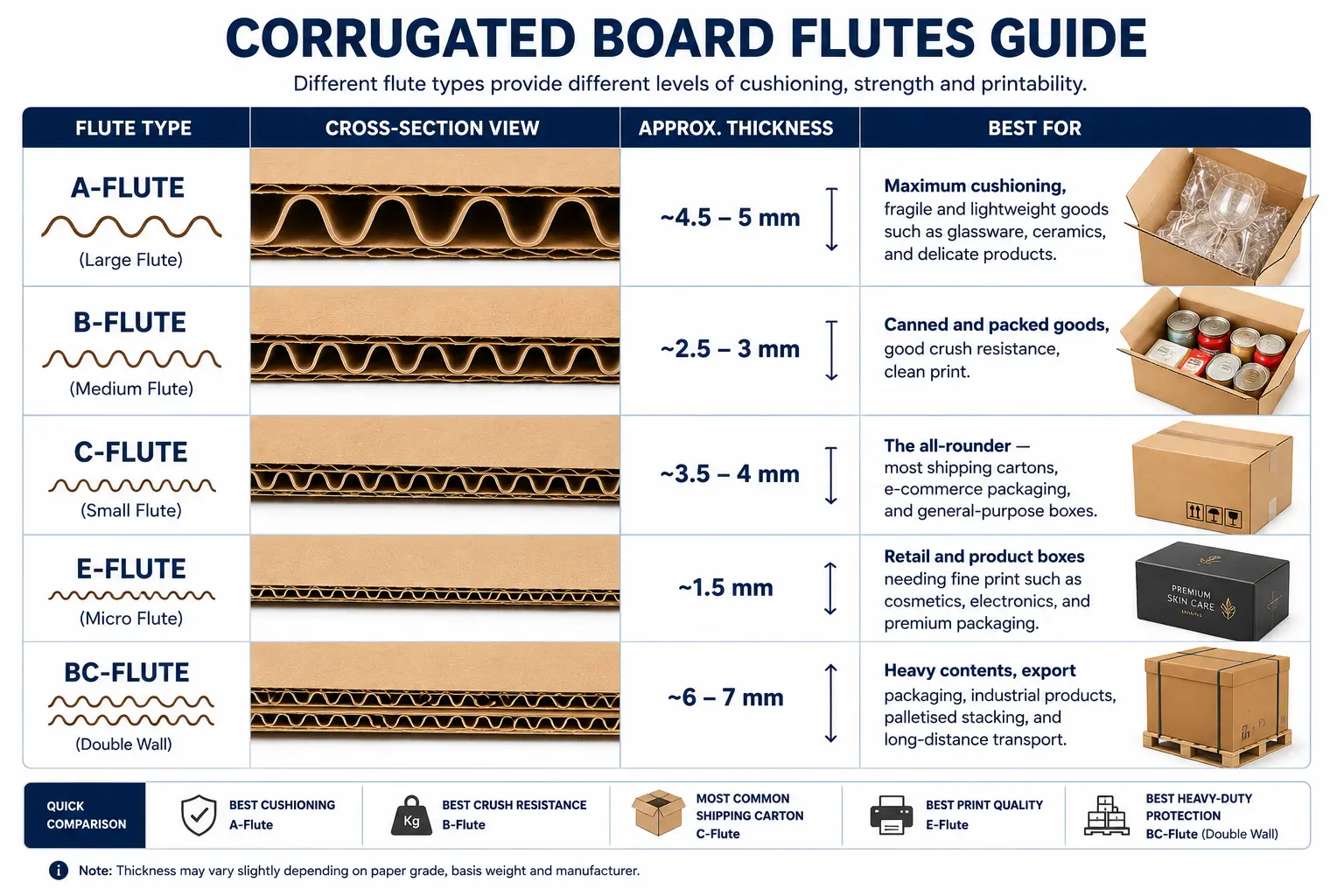
| Flute | Approx. thickness | Best for |
|---|---|---|
| A-flute | ~4.5–5 mm | Maximum cushioning, fragile and lightweight goods |
| B-flute | ~2.5–3 mm | Canned and packed goods, good crush resistance, clean print |
| C-flute | ~3.5–4 mm | The all-rounder — most shipping cartons |
| E-flute | ~1.5 mm | Retail and product boxes needing fine print |
| BC (double wall) | ~6–7 mm | Heavy contents, export, palletised stacking |
Strength is also rated by Bursting Strength (BF / GSM of the paper) and Edge Crush Test (ECT). When you ask for a quote, telling us the product weight and how the boxes will be stacked lets us pick the lightest grade that still passes — which is usually where cost is saved.
Corrugated box sizes chart
Boxes are always measured by internal dimensions — length × width × height, where length is the longer side of the opening. Below are commonly ordered sizes; we manufacture fully custom dimensions on request, so treat this as a starting point rather than a fixed catalogue.
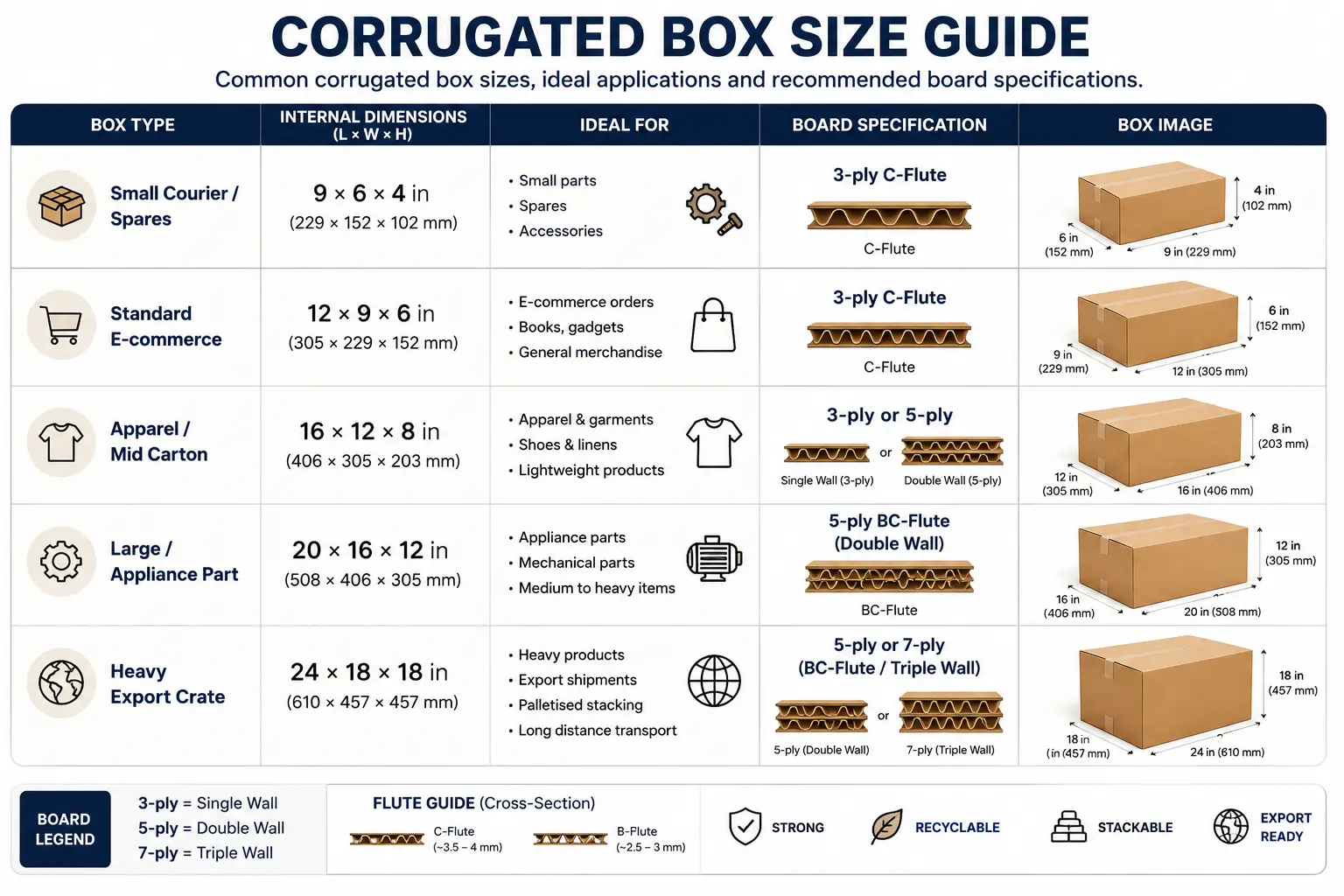
| Use case | Internal size (L × W × H) | Typical grade |
|---|---|---|
| Small courier / spares | 9 × 6 × 4 in (229 × 152 × 102 mm) | 3-ply C |
| Standard e-commerce | 12 × 9 × 6 in (305 × 229 × 152 mm) | 3-ply C |
| Apparel / mid carton | 16 × 12 × 8 in (406 × 305 × 203 mm) | 3-ply / 5-ply |
| Large / appliance part | 20 × 16 × 12 in (508 × 406 × 305 mm) | 5-ply BC |
| Heavy export crate | 24 × 18 × 18 in (610 × 457 × 457 mm) | 5-ply / 7-ply |
What decides the price of a box?
Per-box cost comes down to board area, the number of plies, the paper GSM and BF, print colours, and order quantity. Larger runs bring the unit price down sharply because setup is spread across more boxes. Rather than guess, you can estimate it directly.
Corrugated box price calculator
Enter size, ply and quantity to get an instant indicative rate before you send an enquiry.
Frequently asked questions
Is a corrugated box the same as a cardboard box?
In everyday speech, yes, but technically no. It has a fluted middle layer between two liners, giving it far more strength than plain cardboard (boxboard), which is a single thin layer used for things like cereal cartons.
How do I know which flute or ply I need?
It depends on the weight of your product and how the boxes will be stacked and shipped. As a rule, 3-ply suits light to medium goods and 5-ply handles heavier or export loads. Share your product details and we will recommend the lightest grade that still protects it.
What is the minimum order quantity?
Minimums vary by size and print. Custom-printed boxes carry a higher minimum than plain brown stock. Tell us your size and quantity and we will confirm the MOQ and rate.
Do you make custom sizes and printing?
Yes. We manufacture to your exact internal dimensions and offer flexo and offset printing for branding. The sizes chart above is only a guide to common orders.