
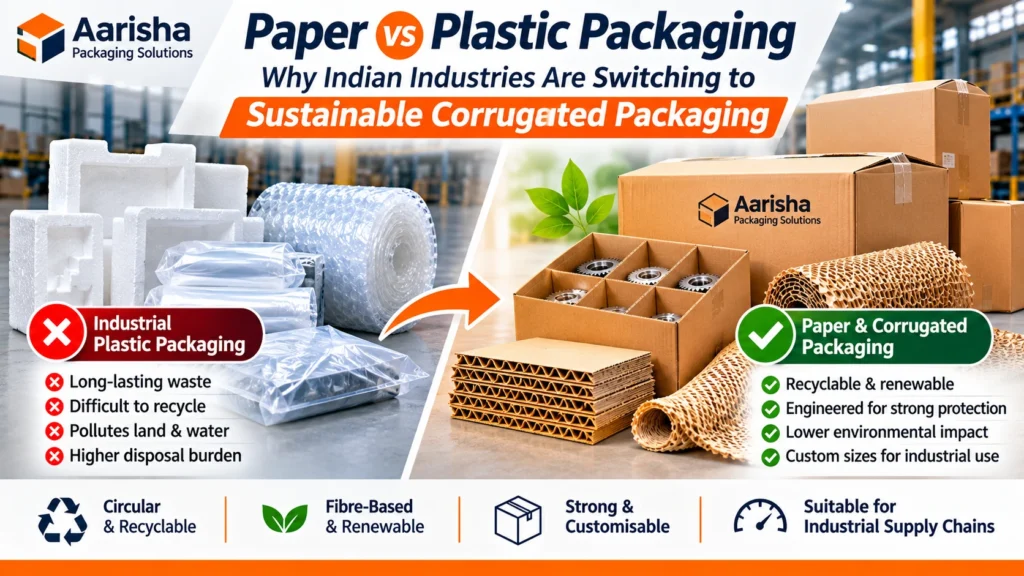
Paper vs Plastic Packaging: Why Industries Are Switching in 2026
Paper vs Plastic Packaging : Why Indian Industries Are Switching to Sustainable Corrugated Packaging The global packaging industry is undergoing a significant transformation. As manufacturers, automotive suppliers, exporters and logistics companies reassess their environmental responsibilities, traditional petroleum-based packaging materials are facing increasing scrutiny. Plastic foam, bubble wrap, thermocol and plastic-laminated cartons have long been used to protect industrial products during storage and transportation. However, concerns about plastic waste, recycling challenges, environmental impact and changing regulatory expectations are encouraging businesses to explore more sustainable alternatives. Among these alternatives, corrugated paper packaging, engineered cardboard boxes and cellulose-based protective materials are emerging as practical solutions for many industrial applications. For India’s manufacturing sector, this transition is particularly relevant. Automotive component manufacturers, engineering companies, electrical equipment suppliers and industrial distributors require packaging that delivers reliable protection without creating unnecessary material waste. The question is no longer simply whether paper can replace plastic. It is about identifying where engineered paper-based packaging can provide comparable protection, better recyclability and improved supply-chain efficiency. For manufacturers operating in Jamshedpur, Adityapur and other industrial centres of eastern India, this transition presents an opportunity to rethink traditional packaging practices. 1. The Growing Environmental Problem of Plastic Packaging Plastic has transformed modern manufacturing and logistics. Its lightweight construction, flexibility, durability and low manufacturing cost have made it one of the most widely used packaging materials. However, the short useful life of many packaging products creates a serious environmental challenge. Unlike durable plastic components designed for repeated use, transit packaging is frequently discarded immediately after a product reaches its destination. Common examples include: Expanded Polystyrene (EPS) foam and thermocol Expanded Polyethylene (EPE) foam Plastic bubble wrap Polyethylene packaging films Plastic strapping and protective sleeves Multi-layer laminated packaging materials When these materials are not properly collected and processed, they can accumulate in landfills, waterways and natural ecosystems. Over time, conventional plastics can fragment into microplastics, creating additional environmental concerns. Why Industrial Plastic Waste Deserves Attention Public discussions about plastic pollution often focus on shopping bags, beverage bottles and consumer packaging. However, industrial transit packaging is another important source of plastic waste. Manufacturing facilities regularly use protective materials to transport products between suppliers, factories, warehouses and customers. A single industrial shipment may contain several layers of plastic protection, including foam blocks, plastic films, bubble wrap and polymer pouches. When these materials are discarded after unpacking, businesses face the challenge of collecting, segregating and disposing of multiple packaging components. This makes industrial packaging redesign an important part of broader waste-reduction strategies. 2. Beyond Retail Packaging: The Hidden Plastic Problem in Industrial Supply Chains Industrial packaging has traditionally prioritised product protection and convenience. Environmental considerations have not always received the same attention. However, manufacturers are increasingly examining the materials used throughout their supply chains. Expanded Polystyrene (EPS) and Thermocol EPS, commonly known as thermocol, is widely used for cushioning appliances, machinery and fragile products. Its lightweight structure provides impact protection, but its low density makes collection, storage and transportation for recycling challenging. Broken EPS pieces can also become dispersed during handling and disposal. EPE Foam and Bubble Wrap Expanded Polyethylene foam and bubble wrap are commonly used to protect metal components, glass products, painted surfaces and electronic equipment. They provide flexibility and cushioning, but their recovery depends on collection, sorting and recycling infrastructure. Contaminated or mixed-material plastic packaging may be difficult to process through conventional waste-recovery systems. Plastic-Laminated Corrugated Cartons Some cardboard boxes are coated with polyethylene films or laminated with other plastic materials to improve moisture resistance and appearance. Although these cartons contain paperboard, the additional polymer layer can make fibre recovery more difficult. This creates a packaging-design challenge: improving moisture resistance without unnecessarily compromising recyclability. Plastic Crates and Returnable Packaging Reusable plastic crates can be effective in controlled distribution networks where containers are regularly returned, inspected and reused. However, their environmental performance depends on the number of reuse cycles, transportation distances, cleaning requirements and loss rates. For businesses operating across multiple suppliers and destinations, managing returnable packaging can become complicated. The Problem of Mixed-Material Packaging Combining cardboard cartons with plastic foam inserts, plastic films, synthetic tapes and laminated surfaces creates a mixed-material waste stream. If these materials are not separated correctly, the recovery of otherwise recyclable paperboard can become more difficult. This is why packaging manufacturers are increasingly exploring mono-material and fibre-based alternatives. 3. Why Cellulose-Based Packaging Is Gaining Importance Paper and corrugated board are primarily made from cellulose fibres, a natural material derived from plant-based sources. Unlike conventional petroleum-based plastics, cellulose fibres can be processed through established paper-recycling systems. This gives paper-based packaging an important advantage in applications where material recovery is practical. Recyclability Through Paper Recovery Systems Used corrugated cartons can be collected, sorted and sent to paper mills for recycling. During the recycling process, paperboard is mixed with water in specialised equipment to separate the fibres. The recovered fibres can then be cleaned and used in the manufacture of new paper products. The quality and number of times fibres can be recycled depend on their condition, length, contamination and the paper-making process. Natural Fibre-Based Material Cellulose is a renewable plant-derived material. Paper packaging can therefore offer an alternative to fossil-fuel-based packaging, particularly when manufacturers use recovered paper and responsibly sourced virgin fibres. However, responsible sourcing, water consumption, energy use, manufacturing emissions and end-of-life recovery must all be considered when evaluating environmental performance. Better Compatibility With Established Paper Recycling Corrugated packaging has an established collection and recycling ecosystem in India. This makes it a practical material for businesses looking to reduce their dependence on certain single-use plastic packaging products. For the best recycling outcomes, businesses should avoid unnecessary plastic laminations, coatings and mixed-material components wherever the application allows. 4. How Engineered Corrugated Packaging Can Replace Industrial Plastics One of the biggest misconceptions in industrial packaging is that paperboard cannot provide sufficient protection for heavy or delicate products. Modern corrugated packaging design has expanded considerably beyond ordinary shipping cartons. Through customised board construction, die-cut inserts, partitions, multi-wall cartons and honeycomb structures, paper-based