Corrugated Box Specifications: Complete Buyer’s Guide
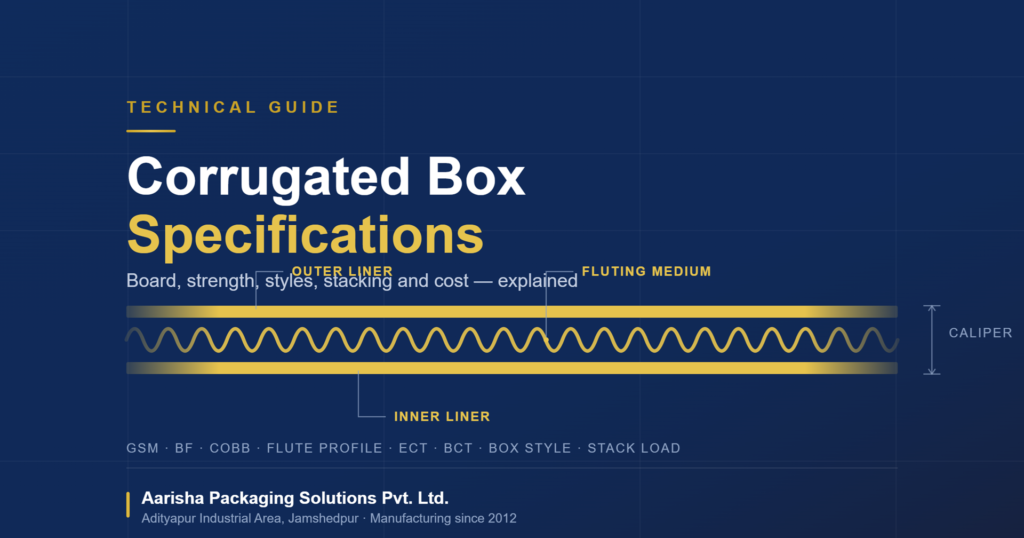
Corrugated Carton Boxes: The Complete Technical Guide for Buyers Most packaging problems are specification problems. Corrugated box specifications get written from habit rather than from the load, and the result is either a carton that fails in transit or one that costs 30% more than it needed to. This guide walks through every decision behind a carton — board, strength, style, size, print, closure, stacking, testing, compliance, cost — the way we work through it on the floor at our Adityapur Industrial Area plant in Jamshedpur. We have been manufacturing corrugated boxes since 2012, running roughly 5 lakh boxes a month for customers across Jharkhand, Bihar, Odisha and West Bengal. Ply selection — the choice between 3-ply, 5-ply and 7-ply construction — is covered separately in our dedicated ply guide. Everything else lives here. What this guide covers Anatomy of a corrugated board Kraft paper: GSM, BF and Cobb value Flute profiles and why they change everything Strength metrics: bursting strength, ECT and BCT Box styles and when each one earns its keep Dimensioning without costly mistakes Printing and branding options Closure and sealing methods Stacking, load and warehouse derating Testing and quality control Compliance, marking and export requirements How transit mode changes the specification Where the money actually goes Diagnosing a failed carton Writing corrugated box specifications: what to send us Section 1Anatomy of a Corrugated Board A corrugated board is not cardboard. Cardboard is a single thick sheet; corrugated board is an engineered sandwich, and the engineering is where the strength comes from. Three components repeat through every board grade: Liners — the flat outer sheets of kraft paper. The outer liner carries print and takes abrasion; the inner liner faces the product. Fluting medium — the wavy paper glued between liners. Each arch acts as a miniature column. Stand a board on its edge and the flutes carry the vertical load; that is the entire structural principle. Glue lines — starch adhesive bonding flute tips to liners. Weak glue lines are a silent defect: the board looks correct and delaminates under humidity. Ply count is simply how many of these layers are stacked. A single-wall board is liner–flute–liner, which the Indian trade calls 3-ply. Add a second flute and liner and you have 5-ply, double wall. Add a third and you reach 7-ply, triple wall. The arithmetic is easy; the consequence is that ply alone tells you almost nothing about strength. A 5-ply box built from 100 GSM 12 BF paper will fail under a load that a well-built 3-ply carton carries comfortably. The single most common buying error: asking for a ply count and nothing else. A purchase order that reads “5-ply box, 400 × 300 × 300 mm” is not a specification. It leaves the paper grade, flute profile, and strength rating entirely to whoever is quoting — which means the cheapest bid wins on paper and loses in transit. Section 2Kraft Paper: GSM, BF and Cobb Value Roughly 65–70% of a carton’s cost is the paper. It is also where quality is won or quietly lost, so three numbers deserve your attention. GSM — grammage Grams per square metre. This measures how much paper is present, not how strong it is. Liner GSM commonly runs from 100 to 250 for corrugated work; fluting medium usually sits between 100 and 150. Higher GSM adds thickness, stiffness and rupees. It does not automatically add burst resistance, which is why GSM and BF must be read together. BF — bursting factor Bursting factor is the Indian trade’s shorthand for the paper’s resistance to rupture, and it is the number that actually separates a good carton from a poor one. Mills supply kraft in grades from about 12 BF up to 35 BF and beyond. In practice: BF grade Typical use Notes 12–16 BF Light retail, low-value goods, short local moves Economical; poor tolerance for rough handling or damp 18–20 BF General FMCG, e-commerce, hardware, garments The workhorse range for most Indian shippers 22–25 BF Auto components, engineering goods, heavier loads Common through the Jamshedpur–Adityapur industrial belt 28–35 BF Steel fasteners, castings, export, high stacking Where compression and puncture both matter Cobb value — moisture resistance Cobb measures how much water a square metre of paper absorbs in 30 minutes, expressed in grams. Lower is better. This number matters far more in eastern India than most buyers realise. A carton that performs perfectly in a February despatch from Jamshedpur can lose a substantial share of its compression strength sitting in a Kolkata or Patna godown during the monsoon, because the paper has taken on moisture and the flutes have softened. If your goods are stored for weeks in humid conditions, ask for a controlled Cobb value or a moisture-resistant coating rather than simply buying a heavier board. Virgin versus recycled fibre Recycled kraft dominates the Indian market and performs perfectly well for most applications. Virgin fibre offers longer fibre length, better burst at equivalent GSM, and more consistent appearance for premium print. Recycled content also varies batch to batch, which is the honest argument for specifying strength by test result rather than by paper description. Section 3Flute Profiles and Why They Change Everything Two boards can share ply count, GSM and BF and still behave completely differently, because the flute geometry differs. Flute profile determines the height and frequency of those internal arches. Profile Approx. flute height Character Best for A-flute ~4.7 mm Tall, widely spaced arches; best cushioning and stacking strength Fragile goods, tall stacks, void-heavy packs C-flute ~3.6 mm The compromise profile; good stacking with decent print surface General shipping — the global default B-flute ~2.5 mm Short, dense arches; strong flat-crush resistance, smoother print Canned goods, heavy dense products, retail-facing E-flute ~1.6 mm Thin and rigid with an excellent print face Die-cut retail boxes, small e-commerce items F-flute ~0.8 mm Very fine; near-carton appearance Premium small-format retail packaging In multi-wall boards, profiles are combined — BC and AB flute being common in 5-ply. A