Leading Corrugated Box Manufacturer serving Jharkhand, Bihar, Odisha & West Bengal — Since 2012

best packaging materials for e-commerce
Packaging

Best Packaging Materials for E-commerce Shipping in India: Complete Guide (2026)

Best Packaging Materials for E-commerce Shipping in India: Complete Guide (2026) E-commerce businesses depend heavily on safe and efficient packaging. Choosing the best packaging materials for ecommerce is essential to protect products, reduce returns, and improve customer satisfaction. In this guide, we will explore the most effective packaging solutions used by online sellers in India. Best Packaging Materials for Ecommerce: What You Need to Know Selecting the best packaging materials for ecommerce depends on product type, weight, and shipping distance. The right materials ensure durability, cost efficiency, and brand presentation. 1. Corrugated Boxes (3 Ply, 5 Ply, 7 Ply) Corrugated boxes are the most widely used packaging solution for e-commerce shipping. Best For: Electronics Clothing FMCG products 👉 For strength comparison, read: 3 ply vs 5 ply vs 7 ply corrugated boxes 2. E-commerce Mailer Boxes Mailer boxes are ideal for lightweight and branded packaging. Best For: Subscription boxes Small electronics Cosmetics They provide a premium unboxing experience. 3. Bubble Wrap & Air Bubble Rolls Bubble wrap is essential for fragile product protection. Best For: Glass items Electronics Decorative products It absorbs shocks and prevents damage. 4. EPE Foam Packaging EPE foam offers excellent cushioning for delicate products. Best For: Industrial parts Electronics Fragile goods 5. BOPP Tape & Strapping These materials are used for sealing and securing packages. Best For: Carton sealing Bulk shipments They ensure package stability during transit. 6. Corrugated Sheets & Rolls Used as internal protection inside cartons. Best For: Layer padding Product separation How to Choose the Best Packaging Materials for Ecommerce To select the best packaging materials for e-commerce, consider: Product weight and fragility Shipping distance Packaging cost Storage conditions 👉 Using the right materials reduces damage and improves delivery success. Benefits of Using the Right Packaging Materials Choosing the best packaging materials for ecommerce helps: Reduce product returns Improve customer satisfaction Lower shipping costs Enhance brand image Packaging Tips for E-commerce Businesses Use strong corrugated boxes for shipping Add cushioning for fragile items Seal packages properly with BOPP tape Choose eco-friendly materials 👉 For more tips, read: packaging tips for businesses Conclusion Selecting the best packaging materials for e-commerce is crucial for business success in today’s competitive market. From corrugated boxes to protective materials, each component plays a vital role in safe delivery and customer experience. By choosing the right packaging strategy, businesses can reduce costs, prevent damage, and build customer trust. FAQs Q1. What are the best packaging materials for ecommerce shipping? A. Corrugated boxes, bubble wrap, EPE foam, and BOPP tape are widely used for safe shipping. Q2. Which box is best for e-commerce products? A. 3 ply boxes for light items, 5 ply for medium, and 7 ply for heavy shipments. Q3. How can I reduce product damage during shipping? A. Use strong boxes and proper cushioning materials. Q4. Are eco-friendly packaging materials available? A. Yes, many recyclable and sustainable options are available. Q5. Why is packaging important in e-commerce? A. It protects products, reduces returns, and improves customer satisfaction. Planning to order corrugated boxes for your ecommerce shipments? Calculate your box price instantly before you place an order.

3 Ply vs 5 Ply vs 7 Ply Corrugated Boxes
Packaging

3 Ply vs 5 Ply vs 7 Ply Corrugated Boxes: Which One is Best for Your Packaging Needs?

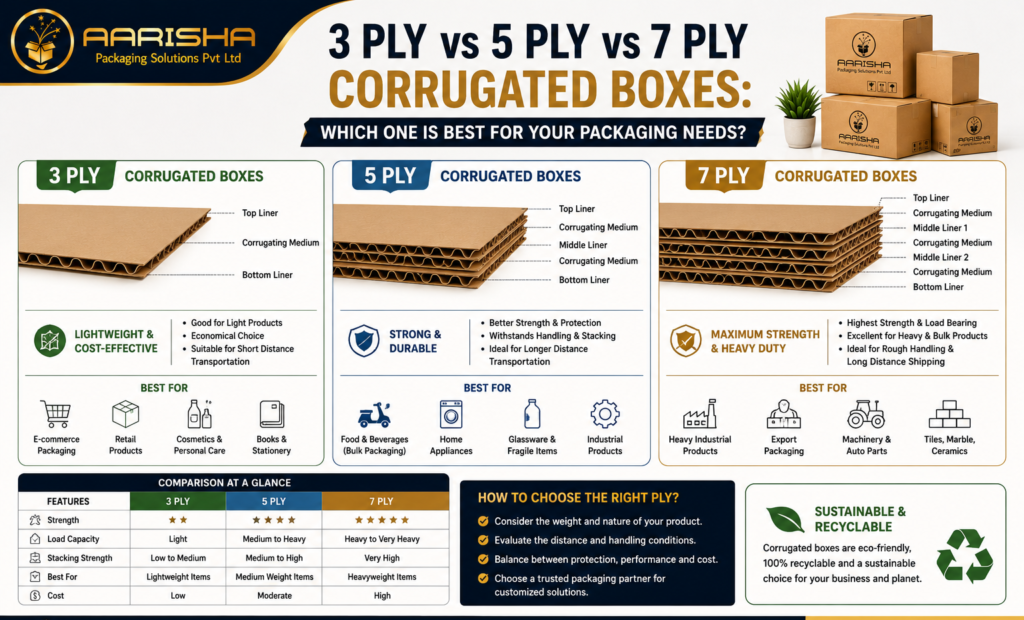
3 Ply vs 5 Ply vs 7 Ply Corrugated Boxes – Which One Does Your Business Actually Need?   Every week we get calls from buyers across Jharkhand and Bihar who have had the same bad experience. They ordered corrugated boxes, the boxes arrived, they packed their goods, and somewhere between the warehouse and the customer — the box failed. Crushed bottom. Burst side wall. Collapsed under stacking. Product damaged. Customer unhappy. When we ask what ply they were using, most of them go quiet. They did not know there was a choice. They just asked for “corrugated boxes” and got whatever the supplier decided to send. That one decision — ply selection — is probably the most underdiscussed topic in Indian packaging procurement. So let us fix that right now. What Does “Ply” Actually Mean? Cut open any corrugated box and look at the edge of the cardboard. You will see flat sheets — called liners — with wavy layers between them. Those wavy layers are called fluting. The fluting is where all the strength comes from. It acts like a series of tiny arches, absorbing pressure, resisting compression, and cushioning whatever is inside. Ply simply tells you how many of these layers the box wall has. More layers means more strength, more weight capacity, and more protection — but also more material cost. The art is in matching the right ply to your actual requirement. Here is the simplest way to check what you currently have: look at the cut edge of any carton flap. Count the rows of waves. One row of waves — that is 3 ply. Two rows — 5 ply. Three rows — 7 ply. If your current supplier has been sending you 3 ply for a job that needs 5 ply, you now know the reason behind your damage claims. 3 Ply Corrugated Boxes (Single Wall) Three ply is the most commonly used corrugated board in India — and it is also the most commonly misused one. It consists of one layer of fluting between two flat liners. Simple, lightweight, economical, and entirely appropriate for the right applications. Where 3 ply works well: small eCommerce parcels, apparel and garments, stationery, books, light FMCG products, pharma strip packaging, and anything under 8 to 10 kg that travels short distances via courier. For Flipkart and Amazon sellers shipping small consumer items within the same state, 3 ply is perfectly adequate and keeps packaging costs low. Where 3 ply fails: the moment you load it with metal parts, stack it more than two or three high in a truck, or send it on a long road freight journey across multiple transfers. The single flute simply does not have the compression strength to handle sustained load. Buyers who use 3 ply for industrial goods are essentially gambling on transit conditions being perfect — and in India, they rarely are. One thing worth knowing: 3 ply boxes can be made stronger by using higher GSM paper. A 3 ply box made with 150 GSM kraft liner will outperform one made with 100 GSM liner by a significant margin. So when comparing quotes, always ask about the GSM — not just the ply. 5 Ply Corrugated Boxes (Double Wall) Five ply has two layers of fluting and three flat liners. That additional flute changes everything. The double-wall construction dramatically improves bursting strength, compression resistance, and shock absorption. This is the configuration we recommend most often to industrial buyers in Jharkhand and Bihar. Where 5 ply works well: electronics, LED televisions, kitchen appliances, industrial tools, auto components, glassware, heavy retail goods, and anything in the 15 to 40 kg range that will be stacked in a warehouse or transported across state lines. If you are sending goods from Jamshedpur to Kolkata, or from Dhanbad to Delhi, 5 ply is the sensible default for industrial freight. The stacking advantage is particularly important. When boxes are stacked four or five high — which is standard in most Indian warehouses and trucks — the bottom boxes bear the full weight of everything above. A 3 ply box in that position will deform and eventually collapse. A well-made 5 ply box holds its shape under that load without issue. The cost difference between 3 ply and 5 ply is real but it is almost always offset. One round of damage claims, one returned shipment, one lost client — any of these will cost more than the difference in packaging cost across dozens of orders. Five ply is not a premium luxury. For most manufacturers and traders, it is the responsible baseline. 7 Ply Corrugated Boxes (Triple Wall) Seven ply is in a different category. Three layers of fluting, four liners, a wall thickness that approaches thin plywood. This is not a box — it is a shipping enclosure. And for the right applications, it is the only thing that makes sense. Where 7 ply works well: heavy machinery, automotive assemblies, bulk chemicals, export consignments by sea freight, goods being crane-handled or container-stacked, and any product where a packaging failure would cause serious commercial damage. If you have previously been using wooden crates for heavy industrial goods, 7 ply corrugated is a credible alternative — lighter, more eco-friendly, and significantly easier to handle and dispose of at the destination. A common question we hear: does 7 ply handle moisture better? Yes — not because the paper itself is different, but because the sheer thickness of the wall makes it far harder for moisture to penetrate through to the product. For sea freight or goods stored in humid conditions, this matters. Another question: can I just use 3 ply with heavy bubble wrap inside for heavy mechanical parts? No. Bubble wrap protects against scratches and surface damage. It does nothing for stacking strength. A 3 ply box loaded with metal parts will collapse under its own stacking load regardless of how well you have padded the inside. The box wall needs to be strong enough

Packaging Materials
Packaging

Different Types and Uses of Packaging Materials: Complete Guide for Businesses

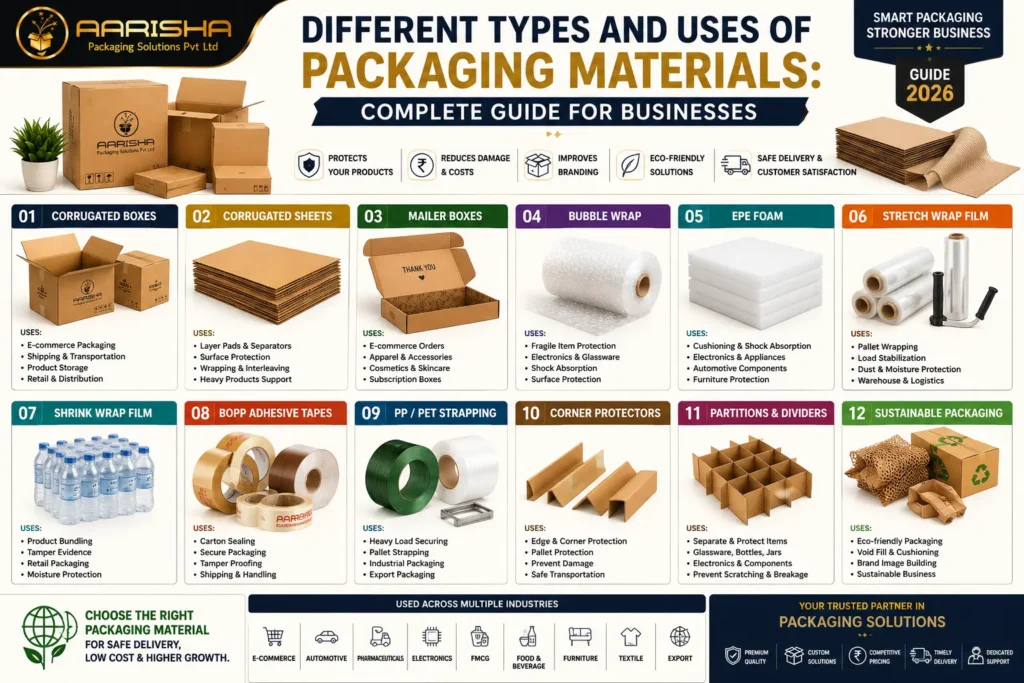
Types of Packaging Materials and Their Uses – A Practical Guide for Indian Businesses   Most guides on packaging materials read like they were written by someone who has never actually packed a product. They list materials, add bullet points, and call it a day. This one is different. We manufacture corrugated packaging in Jamshedpur and supply businesses across Jharkhand, Bihar, and West Bengal — so what we know about packaging comes from real orders, real problems, and real buyers asking the right questions too late. This guide covers the main packaging materials used by Indian manufacturers, traders, and eCommerce sellers — what each one does, where it works, where it fails, and how to decide what your business actually needs. 1. Corrugated Boxes – The Workhorse of Indian Packaging   If there is one packaging material that holds Indian supply chains together, it is the corrugated box. From Flipkart fulfilment centres to steel component traders in Jharkhand to pharmaceutical distributors in Bihar — corrugated is everywhere, and for good reason. It is strong, lightweight, recyclable, customisable, and available at scale. But “corrugated box” is not one thing. The ply configuration changes everything. 3 Ply (Single Wall) — One layer of fluting between two liners. Economical and adequate for light products under 10 kg, short-distance courier shipments, apparel, FMCG, stationery, and inner cartons. Misused constantly for heavy industrial goods where it has no business being. 5 Ply (Double Wall) — Two layers of fluting, three liners. The right choice for most industrial buyers — handles 15 to 40 kg loads, stacks well in warehouses and trucks, provides real shock absorption for electronics, appliances, auto components, and tools. If you are shipping goods by road freight across state lines, 5 ply is the sensible default. 7 Ply (Triple Wall) — Three layers of fluting, four liners. Approaches thin plywood in thickness and compression strength. Built for heavy machinery, export consignments, sea freight, crane-handled goods, and anything where a box failure would cause serious commercial damage. Can often replace wooden crates. One thing most buyers overlook: GSM matters as much as ply. A 5 ply box made with 120 GSM liner paper will be noticeably weaker than one made with 150 or 175 GSM. When comparing quotes, always ask about the GSM combination — not just the ply count. Best for: eCommerce shipping, FMCG secondary packaging, industrial freight, export packaging, warehouse storage, auto components, electronics, pharma distribution. 2. Duplex and Folding Carton Boxes   Duplex cartons are the boxes you see on pharmacy shelves, cosmetic counters, and food retail displays. They are made from duplex board — a thick paperboard with a white coated surface on one side — and are designed primarily for presentation and retail rather than heavy-duty transit protection. They print beautifully. The white coated surface takes colour well, which makes them the preferred choice for brands that care about how their product looks on a shelf or in a customer’s hands. Pharmaceutical companies use them for strip packaging and medicine boxes. Cosmetic brands use them for serum boxes, cream cartons, and gift packaging. Food companies use them for cereal boxes, dry snack packaging, and bakery items. What they are not: a transit packaging solution for heavy goods. Duplex cartons are inner or retail packaging. They go inside a corrugated shipper, not instead of one. Best for: Pharmaceutical products, cosmetics, food retail, consumer goods branding, gifting, and any application where product presentation drives purchase decisions. 3. Mailer Boxes for eCommerce   The Indian eCommerce market has created a specific packaging requirement that did not really exist a decade ago — a box that functions as both the shipping container and the unboxing experience. Mailer boxes do exactly that. A mailer box is a self-locking corrugated box, typically made from 3 or 5 ply board, designed to be opened by the end customer rather than by a warehouse team. They tuck together without tape, open cleanly, and look intentional rather than industrial. For D2C brands selling on their own website or through premium marketplaces, the mailer box is often the first physical brand touchpoint the customer has. Where Indian sellers get this wrong: they treat mailer boxes as a cosmetic choice and cut corners on board quality. A thin, flimsy mailer box that arrives crushed is a worse brand impression than a plain corrugated box that arrives intact. Get the board quality right first, then invest in printing and design. Best for: D2C brands, Amazon and Flipkart premium sellers, subscription box services, gifting businesses, small electronics, apparel, and beauty products. 4. Bubble Wrap and Air Bubble Rolls Bubble wrap is surface protection, not structural protection. This distinction matters and is routinely ignored by Indian buyers who assume that more bubble wrap inside a weak box will compensate for the box itself. It will not. What bubble wrap does well: it protects product surfaces from scratches, abrasions, and minor impact during handling. For glass items, decorative products, finished electronics, and polished metal components, bubble wrap prevents cosmetic damage that would otherwise result in returns. What bubble wrap cannot do: provide stacking strength. If your box wall is not strong enough to hold its shape under load, bubble wrap inside the box makes no difference to the outcome. The structural integrity requirement must be met by the box itself. Air bubble rolls come in different bubble sizes. Small bubbles (10mm) suit lightweight fragile items like glassware and ceramics. Large bubbles (25mm or more) provide better cushioning for heavier or more impact-sensitive products. Best for: Glass and ceramic products, finished electronics, polished decorative items, fragile industrial components, inner protection inside corrugated shippers. 5. EPE Foam Rolls and Sheets   EPE (Expanded Polyethylene) foam is a step up from bubble wrap for industrial applications. It is denser, more durable, provides better shock absorption over repeated handling cycles, and does not pop or compress permanently like bubble wrap does. Once you compress EPE foam, it returns to shape — which means it keeps protecting

Packaging

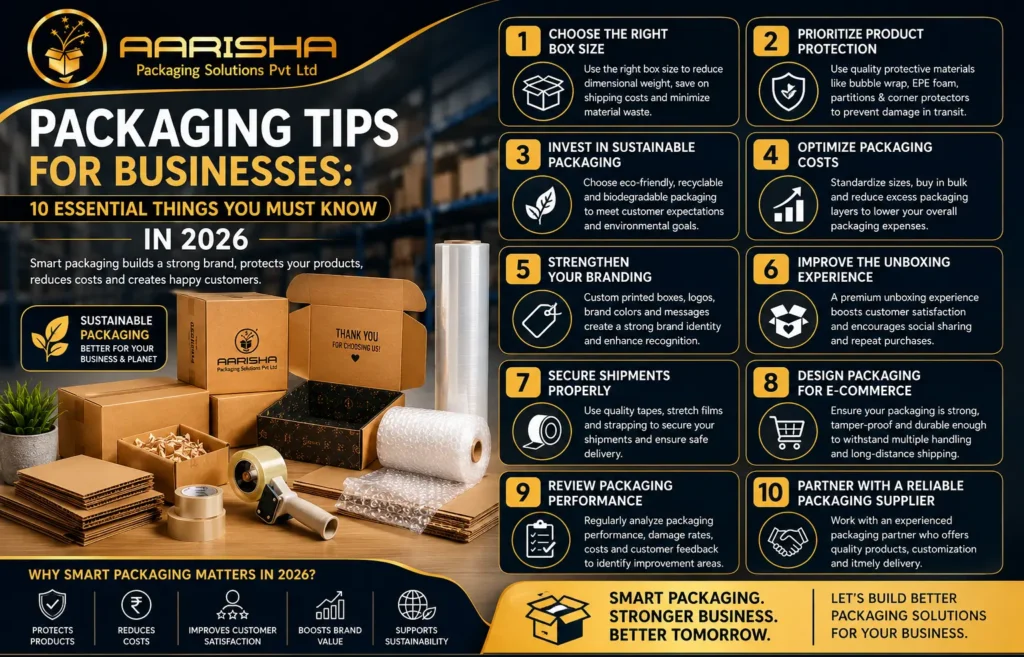
Packaging Tips for Businesses : 10 Essential Things You Must Know in 2026

Whether you run an e-commerce store, a food brand, or a manufacturing unit — packaging is one of the most important decisions you will make for your business. Bad packaging leads to damaged products, unhappy customers, and lost money. Good packaging builds trust, protects your products, and even boosts your brand image. At Aarisha Packaging, we work with businesses of all sizes to deliver smart, cost-effective, and high-quality packaging solutions. In this guide, we share 10 essential packaging tips for businesses that every business owner must know in 2026. 1. Always Choose the Right Material for Your Product The first and most important packaging tip is to match the material to your product’s needs. Corrugated boxes – Best for heavy or fragile products, e-commerce shipping, and bulk orders Rigid boxes – Ideal for premium products like electronics, cosmetics, and gifts Flexible packaging – Great for food items, snacks, and liquids Kraft paper bags – Perfect for retail, bakery, and eco-conscious brands Choosing the wrong material leads to product damage, customer complaints, and higher return rates. 2. Don’t Ignore Box Strength (Burst Strength & GSM) When ordering packaging, always check the GSM (grams per square metre) and burst strength of the material. Higher GSM = thicker and stronger material. Higher burst strength = better resistance to pressure and impact during transit. For heavy products or long-distance shipping, always choose corrugated boxes with a minimum burst strength of 150 BF (Bursting Factor). 3. Right-Size Your Packaging to Cut Costs One of the most overlooked packaging tips for businesses is right-sizing — using packaging that fits your product properly. Oversized boxes waste material and increase cost, require more void fill like bubble wrap or paper, and lead to higher courier charges due to dimensional weight pricing. Order custom-sized boxes from Aarisha Packaging to eliminate wasted space and reduce your per-unit packaging cost significantly. Check our Universal Boxes for the right fit. 4. Invest in Custom Printed Packaging for Brand Identity Plain brown boxes are a missed opportunity. Custom printed packaging turns every shipment into a brand experience. Benefits include instant brand recognition, an unboxing experience customers share on social media, increased perceived product value, and differentiation from competitors. Even a simple logo print or brand color on the box makes a powerful difference. 5. Go Eco-Friendly — Customers Notice and Care Sustainability is no longer optional. In 2026, more buyers — especially B2B buyers — actively prefer suppliers who use eco-friendly packaging. According to Statista, eco-friendly packaging demand is rising every year globally. Eco-friendly options from Aarisha Packaging include recycled corrugated boxes, biodegradable packaging materials, kraft paper bags and wraps, and plastic-free void fill alternatives. Going green also helps you meet regulatory compliance for export and certain industry standards. 6. Test Your Packaging Before Scaling Before ordering in bulk, always test your packaging with real products. Drop test: Drop the packed product from 3 to 4 feet height Compression test: Stack boxes and check if they hold weight Transit test: Ship a few samples and inspect on arrival This saves you from bulk ordering packaging that fails in real-world conditions. 7. Use the Correct Sealing Method Sealing is just as important as the box itself. Poor sealing leads to tampered or opened packages on delivery. BOPP tape – Standard and affordable for most shipments Water-activated tape (WAT) – Stronger bond, tamper-evident, preferred for heavy boxes Self-seal adhesive flaps – Convenient for retail and e-commerce mailers Hot melt glue – Used in automated packaging lines for speed Always use tape that is at least 2 inches wide for corrugated boxes. See our Ecommerce Mailer Boxes for ready-to-ship packaging solutions. 8. Label Clearly — Inside and Outside Clear labelling prevents mishandling and speeds up logistics. Must-have labels include Fragile stickers for delicate items, This Side Up arrows for products with orientation, Keep Dry or Keep Cool for sensitive goods, barcodes and QR codes for inventory tracking, and return address and dispatch details. For e-commerce, ensure your shipping label is printed clearly and stuck firmly on a flat surface of the box. 9. Plan for Seasonal and High-Volume Demand in Advance One of the biggest mistakes businesses make is ordering packaging at the last minute during peak seasons like Diwali, year-end sales, or new product launches. Place bulk orders 4 to 6 weeks before your peak period to avoid stock shortages, get better pricing on large quantities, and allow time for custom printing and quality checks. Aarisha Packaging offers bulk order discounts and advance booking for seasonal demand planning. 10. Partner with a Reliable Packaging Supplier Your packaging supplier is a long-term business partner, not just a vendor. A reliable supplier ensures consistent quality across every order, on-time delivery without delays, flexibility to scale up or down as your business grows, and expert guidance on choosing the right packaging. At Aarisha Packaging, we are committed to delivering world-class packaging solutions tailored to your business needs — whether you need 100 boxes or 1,00,000. Explore our Bottom Lock Boxes and Universal Boxes today. Conclusion Smart packaging is not just about protecting your product — it is about protecting your brand, your customers’ experience, and your bottom line. By following these 10 packaging tips for businesses, you can reduce costs, improve product safety, and build a stronger brand identity. Ready to upgrade your packaging? Contact Aarisha Packaging today for a free consultation and custom quote. 📞 +91 7004087283 📧 contact@apspl.net 🌐 aarishapackaging.com

3 Ply vs 5 Ply vs 7 Ply Corrugated Boxes
Packaging

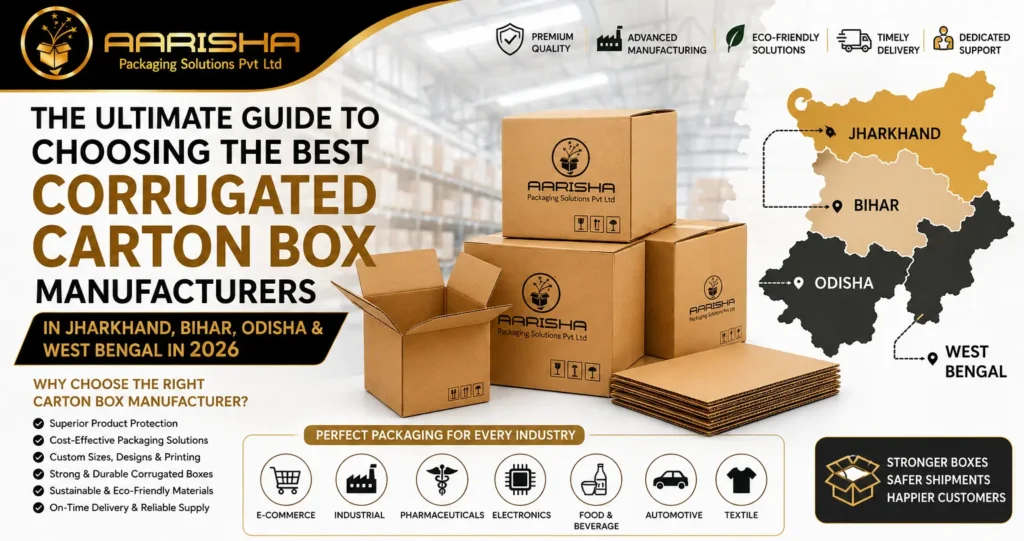
The Ultimate Guide to Choosing the Best Corrugated Carton Box Manufacturers in Jharkhand, Bihar, Odisha & West Bengal in 2026

The Ultimate Guide to Choosing the Best Corrugated Carton Box Manufacturers in Jharkhand, Bihar, Odisha & West Bengal in 2026 Choosing the right packaging partner is critical for businesses dealing with logistics, manufacturing, and e-commerce. When searching for the best corrugated carton box manufacturers, companies must evaluate quality, pricing, reliability, and service capabilities. In Eastern India—especially Jharkhand, Bihar, Odisha, and West Bengal—the demand for corrugated packaging is rapidly increasing due to industrial growth and e-commerce expansion. This guide will help you identify the best corrugated carton box manufacturers and make the right decision for your business. Why Corrugated Carton Boxes Are Essential Corrugated boxes are widely used because they offer: High strength and durability Lightweight structure Cost-effective packaging Eco-friendly and recyclable material Businesses prefer corrugated cartons for safe transportation and storage of goods. Best Corrugated Carton Box Manufacturers: Key Factors to Consider When selecting the best corrugated carton box manufacturers, consider the following: 1. Product Quality & Strength The manufacturer should provide: 3 ply, 5 ply, and 7 ply boxes High burst strength Moisture resistance Quality directly impacts product safety during transit. 2. Customization Options Top manufacturers offer: Custom sizes and designs Printed branding on boxes Die-cut and special packaging solutions Customization helps improve brand visibility. 3. Production Capacity Reliable manufacturers must have: Large-scale production units Ability to handle bulk orders Timely delivery systems This is important for growing businesses. 4. Industry Experience Experienced manufacturers understand: Packaging standards Logistics challenges Industry-specific requirements Always choose companies with proven expertise. 5. Service Area Coverage The best corrugated carton box manufacturers should serve: Jharkhand (Jamshedpur, Ranchi, Dhanbad) Bihar (Patna and nearby regions) Odisha West Bengal Wider coverage ensures better supply chain support. Top Industries That Need Corrugated Packaging The best corrugated carton box manufacturers cater to multiple industries: E-commerce & retail FMCG products Pharmaceuticals Automotive parts Electronics Each industry requires different packaging strength and design. How to Identify Reliable Manufacturers To find the best corrugated carton box manufacturers, follow these steps: Check online reviews and ratings Verify certifications and compliance Evaluate product samples Compare pricing and delivery timelines Assess customer support Cost vs Quality: What Should You Prioritize? While choosing among the best corrugated carton box manufacturers, don’t focus only on cost. Low cost → may compromise quality High quality → reduces damage and returns 👉 Always balance cost with durability and reliability. Future Trends in Corrugated Packaging (2026) The packaging industry is evolving with: Eco-friendly corrugated solutions Lightweight yet strong materials Smart and sustainable packaging The best corrugated carton box manufacturers are already adapting to these trends. Conclusion Selecting the best corrugated carton box manufacturers in Jharkhand, Bihar, Odisha, and West Bengal requires careful evaluation of quality, experience, and service capabilities. By choosing the right manufacturer, businesses can ensure product safety, reduce costs, and improve customer satisfaction. FAQs Q1. How do I choose the best corrugated carton box manufacturers? A. Look for quality, customization, experience, and delivery capability before selecting a manufacturer. Q2. Which ply box is best for heavy products? A. 5 ply and 7 ply corrugated boxes are ideal for heavy and fragile goods. Q3. Are corrugated boxes eco-friendly? A. Yes, they are recyclable and environmentally friendly packaging solutions. Q4. Do manufacturers provide customized packaging? A. Yes, most manufacturers offer customized sizes, printing, and designs. Q5. Which industries use corrugated boxes the most? A. E-commerce, FMCG, pharmaceuticals, and electronics industries heavily use corrugated packaging.